
The Taimahi Way
The Taimahi model generates community value that extends beyond individual impact, while challenging societal norms about people’s potential.
It is broken up into a story of four parts:
Founded on meaning
Grounded in high expectations
Built with knowledge
Brought to life by real-world experience
Founded on meaning
Work is important; it gives us purpose. But, meaningful lives are built on more than work alone. Our lives are made richer by a sense of belonging, purpose, and the agency to make decisions for ourselves.
For young adults with learning and intellectual disabilities, traditional systems limit the ability to self-determine, education pathways lack meaning, and equitable paid employment opportunities are out of reach.
This challenge is evident when school finishes. Many people stay in school longer, but don’t develop the skills needed to make the transition into adult life. Without work readiness, social skills and the resilience to overcome life’s obstacles, many young adults find themselves stuck. With limited options to move forward, people become isolated and experience negative impacts to mental and physical health.
For the few young adults who do find employment, the reality is stark. People in these roles still face inadequate treatment at work, social exclusion, pay below the minimum wage, lack of personal growth and little chance for professional development.
The Taimahi Training Programme is set up to address the barriers young disabled people face to integrating into society. We have created a safe work environment where young adults build the required skills to navigate life’s daily challenges. Over time, we aspire for our trainees to apply these skills in all areas of their lives, building the agency and self-determination needed for a meaningful future.
To foster meaning, we weave our core values into everything we do.
The six principles established in collaboration between the Pakeha world view and Te Ao Māori:
Belonging | Whanaungatanga
We are people first. We don’t make assumptions about who somebody is because of their disability.
Service to each other | Manaakitanga
We generate community value. We aspire to provide high-quality products and services that customers genuinely want to purchase.
Mastery | Tuakana/teina
We validate competency, capability, and capacity. We encourage everyone at Taimahi, whether staff or a trainee, to build agency and self-determination through applied learning, gradual improvement.
Storytelling | Pūrākau
We celebrate progress, determination, and resilience. We believe there’s power in the positive stories we tell about ourselves, others, and our kaupapa.
Collaboration | Kotahitanga
We create more together. We see collaboration as more than just working together, it’s about belonging together.
Guardianship | Kaitiakitanga
We look out for each other, our community and the environment. We’re committed to cooking and growing from scratch, reusing, and preserving the Taimahi brand in the Fresh+ store.
Grounded in high expectations
We believe that people can. We recognise the unique value that young people with intellectual and learning disabilities bring to our communities.
This belief is integral to everything we do. It’s why, during the hiring process, we look for people who are open to learning themselves whilst enabling others to learn – the people who celebrate tiny wins, use failure as a learning pathway and demand more from our trainees.
For us, short-term success is a trainee teaching others correctly, with confidence or independently supervising a group. Long term, success means practising agency and self-determination outside of work. We know we’ll have achieved our mission when our graduates have meaningful paid employment, a home of their own, a healthy social life, independent interests and the ability to determine their own future.
Built with knowledge
Our operational model draws on the theory of doughnut economics – an economic principle founded on the idea that meeting people’s essential needs is achieved without exceeding our ecological limits. This means putting people before profit and implementing a circular principle of waste management.
Our training programme is tailored to an applied learning environment. Our teaching methodology draws on management science (standard operating procedures, quality management, and systems thinking) to develop practical skills in a live commercial environment. This is integrated with training aligned with the NZ Employability Framework, delivered through strategies that build emotional intelligence, social and soft skills. Our programme also incorporates physical exercise programmes to develop gross motor skills, physical resilience, mental persistence, and toughness.
We know that the world isn’t designed for disabled people, so our focus is to help people build strategies for navigating typical entry level ways of working in different industries. That’s why our programme is built on three stages: the first is psychological and physical safety, the second is quality, and the third is productivity. As training progresses, we introduce new challenges that add a layer of difficulty and discomfort in a safe way. By doing this, we encourage trainees to learn that mistakes are ok – what matters is learning how to overcome them.
Brought to life by real-world experience
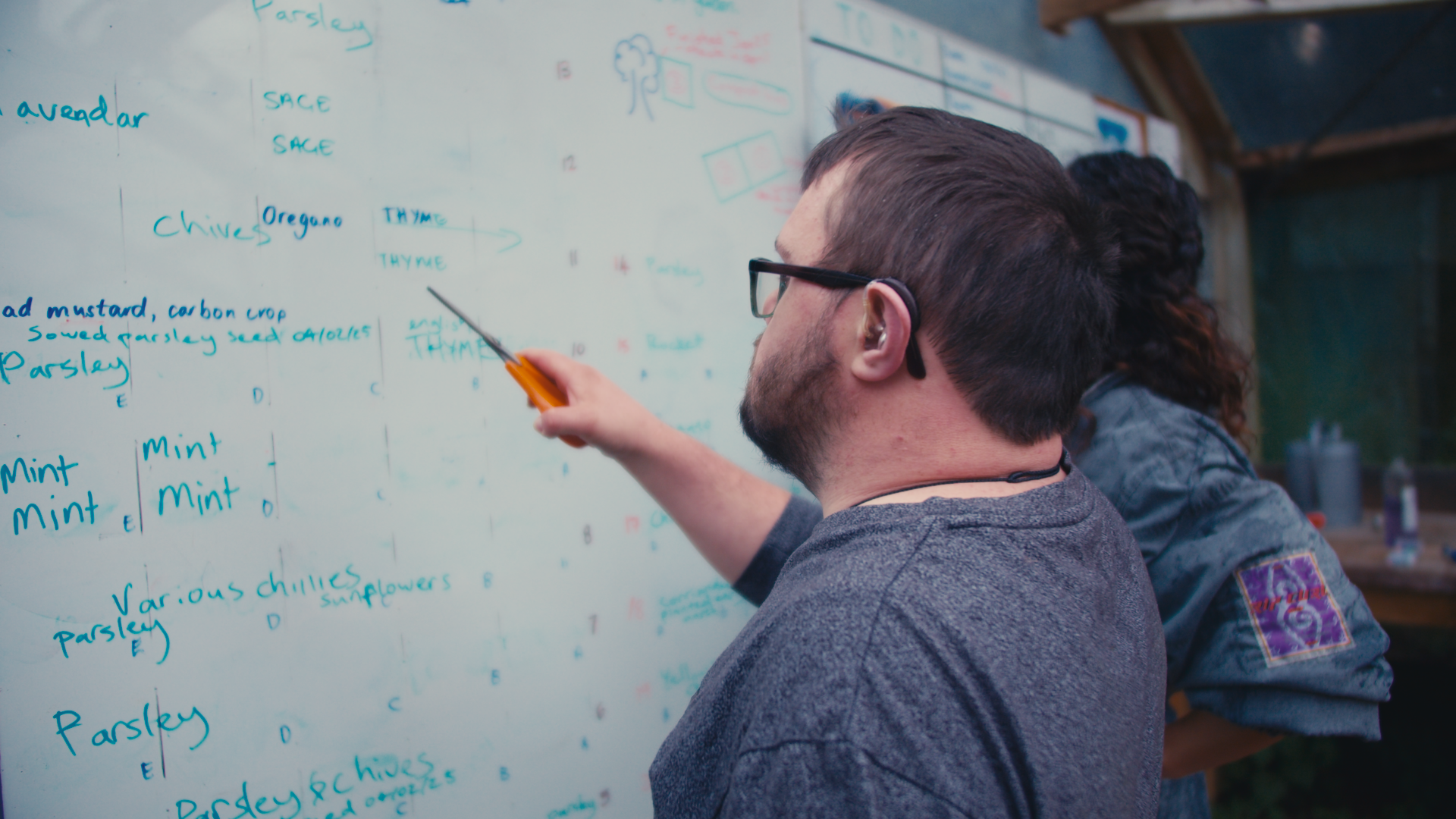
To bring theory to life, Taimahi trainees rotate through daily shifts in different commercial environments – a retail store, kitchen, back-of-house operations and administration, and a herbarium.
During shifts, we teach on-the-job procedures, such as checking produce quality, speaking with customers, and harvesting herbs. To meet individuals’ needs, teaching is delivered through a mix of scaffolded instruction and one-to-one coaching.
Scaffolded instruction is targeted and built to be removed. Our Training Coaches help Trainees learn how to, or learn strategies that help them, achieve a task. This means investing time in helping Trainees make their own decisions, even if that means using simplified language or complex problem-solving on our part.
Practical skills development is supported by a social skills curriculum delivered through workshops and socialisation activities, including group activities, gym classes, and a social club.